Monday, 29 September 2014

Falling Angel - Angel Heart

An article/review by NSFWG member Mark West

When I began writing my novella "The Lost Film" back in 2010 (it's due to be launched at next years FantasyCon and a few of the chapters have been through the group critiquing process), I started reading a lot of crime.  One of the books I decided to re-read (after a perhaps twenty-year break) was "Falling Angel" by William Hjortsberg (1978).  I enjoyed it so much that, the weekend after I finished, my wife & I watched “Angel Heart”, the 1987 film written for the screen and directed by Alan Parker.

Mysterious Press edition
In 1959 New York, Harry Angel is hired by the mysterious Louis Cyphre to track down Johnny Favourite, a crooner who’s been holed up in a hospital since the war. When Angel discovers that the singer is missing, everyone he speaks to on the trail to find Favourite ends up dead. And all the time, the mysterious Cyphre seems to pop up everywhere, not least haunting Harry’s dreams. A hard-boiled private detective novel, employing (and enjoying) every staple of that genre, this takes things into far darker territory as the novel goes on. Sticking to New York throughout (unlike the film), this often seems like it was written with a pang of nostalgia for the city of old and works all the better for it. The ending, as Harry attends a Black Mass in an abandoned subway station, is painful and bitter and unpleasant and serves as a real kick in the gut, before the final denouement. Having read this before (and seen the film a few times), I was surprised at how many obvious clues Hjortsberg seemed to drop at the start (and the cover art doesn’t help), but the clues got more insidious as it went on. This is a cracking novel, working perfectly as either a hardboiled thriller or a supernatural one, never afraid to lay on the violence and gore, but also treating the love affair between Harry and Epiphany with delicate ease. Very highly recommended.

Re-reading this and watching the film so closely together, I’ve realised that they’re equally good, but Parker took a lot of liberties with the source material (some of which are understandable, some not).

Millipede press edition
The book takes place in 1959, the film in 1955 for no apparent reason (though Mickey Rourke does, at one point, mention he’s 37 when he’s clearly not). All of the book takes place in New York (city or state), but the film moves everything to Louisiana for the voodoo sequences (which gives it a different flavour and does make sense, though I like having everything happen in the city). The Epiphany of the book is an independent young woman, assertive and childless - in the film, she’s independent but hampered by circumstance, she has a child and she’s a lot more obviously sexy. In the book, the relationship develops and is mostly nice and pleasant - the film affair virtually starts and ends with the blood-soaked love-making (which is a visual metaphor for the Black Mass (see later), since nothing like this happens in the book). Ethan Krusemark plays a bigger part in the book (there’s a superb little set-piece where Harry has to do some window cleaning) and has a major role to play in the “first” climax, a Black Mass (only briefly glimpsed in the film) that is awful and gripping, which takes place in the underground system. In the film, he’s seen at the races and ends up dead in a cauldron of gumbo.

Do the changes detract from the power? No, I don’t think so, but they’re not really the same animal. It was nice spotting pieces of film dialogue in the novel but I think a film could be made of “Falling Angel”, sticking very close to the source, which would be every bit as powerful as “Angel Heart” was, without usurping its position as a top drawer film based on the book.

So which is better? I’m going to wimp out here, I can’t pick one. I’d love to see a film that sticks to the book but what we got instead is still a top quality piece of entertainment. So I’ll call it a draw and suggest that whichever you go for - book or film - you won’t be disappointed.

1987 UK quad poster

Monday, 22 September 2014

The NSFWG blog celebrates 100 posts!


Well here we are, post 100 for the Northampton SF Writers Group blog.  It's been entertaining, getting from February 16th 2011 to here and we plan on sticking around for at least 100 more posts and hope that you'll keep visiting.

In case you're new to the blog, here are some pointers to the wide and varied content we've published.

Successes of various group members

Articles from group members

Interviews with members

Posts on writing (including top tips from the likes of Group chairman Ian Watson)

Reviews of films and books

and essays about "The Book That Made Me"


Stick around, there's plenty more to come...

Monday, 15 September 2014

Two new YA books from Tim C. Taylor

An article by NSFWG member Tim C. Taylor

Running a publishing business and doing freelance book design doesn’t leave me much time to write any fiction. That’s a shame because I love to write.  During 2013 I made the time and have been scribbling away in the background, as Monday night regulars at the Swan at Bromham can confirm. Rather than write to hit market demographics and all that, I’ve written for pleasure and relaxation, taking as my inspiration my teenage joys of discovering science fiction and fantasy in such sources as 2000AD, Blake’s 7, Doctor Who, and I guess a little from Dungeons & Dragons too.

I’ve written before about how 2000AD influenced me. I didn’t realize at the time that the writers at the comic were mining every cliche of golden age science fiction from the 40s & 50s and then adding their own spin and taking them in new directions in such series as Tharg’s Future Shocks. When I grew older and started to read the golden age science fiction (and much besides) for myself, I was glad 2000AD had mined that storytelling gold because it would have been denied me otherwise. Sometimes I think contemporary adult short science fiction can be too fixated on trying something new, of needing to be clever. Other than an addiction to making jokey reference to contemporary culture and politics, the cleverness of the 2000AD that I loved in the 1970s and 80s was that the writers were (largely) unconstrained: they were allowed to let their imaginations soar in pursuit of storytelling in a way that I suspect short story writers of that time often felt they were not.

And that has been my approach in these stories. There’s Treasure of the Last Dragon, for instance, which is styled a little like the Famous Five stories I was reading to my son at bedtime, except the children are hexapod aliens. I just thought that was a fun thing to do.

The idea of the playthings of super beings being left around the galaxy was a common wonder in early 2000AD (and a cliche long before then). I combined the essence of that sense of wonder, although not the abandoned plaything idea, with a little teenage angst for my story Collision Course.

There was a craze for Dungeons & Dragons while I was at school. We had a strange spread-out school site built up over many decades with gardens that linked various buildings. There was even a gardener named Arthur who let us in his shed at breaktimes to play D&D or just have a chat. The combination of D&D and Arthur’s shed led me to create St. Rushby’s Home for the Un-parented and write a story about a young forensic sorcerer in The Snot Wizard.

Partly the inspiration for these stories came from Gill Shutt’s Alien Legends. Gill was a talented author and source of creative energy who proof read most of these stories before her untimely loss earlier this year. It was Gill who came up with the initial concept of the Repository of Imagination and who gamely let me mess around with her creation to arrive at the form the Repository takes today. The Senior Repositarian of the Earth branch is one Crustias Scattermush, and I’ve written these books under the Crustias penname. Actually, as my friend Elaine Stirling would explain, Crustias is more than a pen name; he is taking on a heteronymic life of his own. So I take no responsibility for his comments at the end of each story, they are purely his own.

Both of these stories are available as two short Kindle books, each costing less than a dollar or pound.

Click here for more info on: Tales from the Repository of Imagination #1 - Treasure of the Last Dragon 

Click here for more info on: Tales from the Repository of Imagination #2 - The Ultimate Green Energy

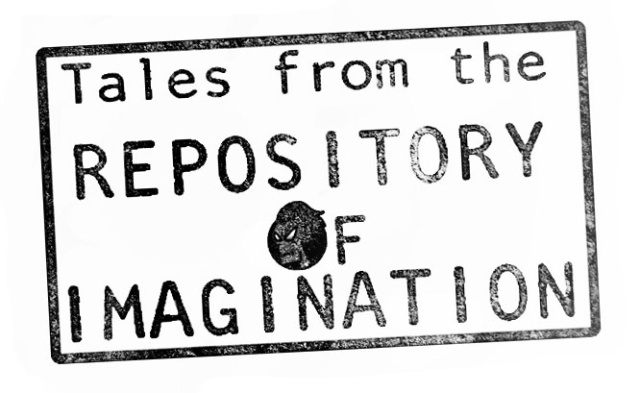
I’m quite pleased with the Photoshopped stamp I created for the series, and so since I’m in a mood to show off today, here’s a bonus stamp. I’ve several more stories sketched out or nearly written, so I hope to be using this stamp many more times.


Crustias portrait  © RATOCA – Shutterstock.com

This originally appeared on Tim's blog in December 2013

Monday, 8 September 2014

Without A Hitch

An article by Chairman Ian Whates

This year, the anthology ‘End of the Road’ (Solaris, edited by Jonathan Oliver) has been shortlisted for both a Shirley Jackson Award and a British Fantasy Award. The following offers some insight into how my story for the book, “Without a Hitch”, came about.

A few years ago I had reason to visit Stephen Baxter at his home in Northumberland. The journey is a long one but not especially complicated – involving, for the most part, a two hundred plus mile slog along the A1. As I set out from Stephen’s for the return trip, RDS kicked in to warn that a major accident had closed the southbound A1 ahead of me. There was a diversion in place but that in turn had become completely jammed and police were advising motorists to expect a delay of up to three hours… I kept track as I drove closer and closer, praying for a miracle. Thankfully, as I skirted Newcastle – still twenty-odd miles short of the incident – the road reopened, but the experience stayed with me. Being a writer, it inevitably triggered the ‘what if…?’ reflex, opening the door to all manner of conjecture. When Jonathan Oliver invited me to submit for the anthology ‘End of the Road’, the memorable trip back from Steve’s instantly sprang to mind.

It wasn’t the only possibility. I also toyed with writing a more fantasy/mediaeval tale, or one featuring an enigmatic road that traversed numerous realities (what might lie at such a road’s eventual end?). However, I kept coming back to the idea of the stranded traveller, of utilising a more mundane setting and featuring a man desperate to get home who suddenly can’t.

I had recently published Chris Beckett’s fabulous second collection, ‘The Peacock Cloak’, via NewCon Press. One of the constituent stories, “Poppyfields”, features Chris’ recurring protagonist Tammy Pendant. I can’t help but admire Tammy for her toughness and her resourcefulness – her survival instinct and willingness to exploit men’s vanities. While plotting my submission for ‘End of the Road’, Tammy came to mind, and I realised she would provide the perfect foil for the developing story. So, I borrowed her (thank you Chris). Oh, this isn’t Tammy, not quite; I gave my character a different context, different motivations, and a more defined cynicism, but the result is definitely Tammy-esque.

Jon Oliver said in his notes introducing “Without a Hitch” in the book that he was surprised, given the anthology’s theme, that mine was the only submission he received that featured a hitchhiker. This gave me pause. Had I taken the easy way out? Had I selected the obvious option that other authors spurned in favour of a greater challenge?

I like to think not. Vanishingly few concepts are truly original; the secret is to twist and shape expectations in an unanticipated fashion to create something distinctive. I’ve never read a story quite like “Without a Hitch”, though some of the constituent elements undoubtedly feel familiar. I know this was the right idea for me to develop for the book, and I’m delighted with the resulting tale. The fact that the editor also liked it is, of course, a very welcome bonus.


Monday, 1 September 2014

The bugbears of Ian Watson (part four)

Group chairman Ian Watson previously contributed two brand new poems to the NSFWG blog (exclusives!), which were - in his words - "attacking misuse of my bugbear words Actinic and Careening".

Inspired, he penned two more which we are presenting here exclusively.  The first regarded "Laying", this time he has his say about "it".

It should also be noted that NSFWG member Nigel Edwards produces IT counts for every story critiqued and fellow member Mark West consistently tops the leaderboard of worst abusers!

It-itis
by Ian Watson

It-it-it-it
Sings the tit tit tit tit
I'm so sick of it-itis.

Enter a room, see a book.
Go into it, see it.
Its cover is blue, just like it.

Take it from it
To its proper place
Where it fits, doesn't it?

I've had it
With It-itis
Non-use of nouns.

It's worse than... ellipsis...
And colonitis:
Is It-itis!

Sings the tit tit tit tit

Isn't it?

Monday, 4 August 2014

We're off on our holidays...

...and we've found the perfect location for a nice, quiet rest.  We've been advised that Mos Eisley has the best nightlife and that the Sarlaac Pit at the Dune Sea is well worth a trip out.


See you in September, with another bugbear from Ian Watson, articles from Ian Whates, Nigel Edwards and more, a look at Stephen King's "Joyland", a milestone anniversary for the blog plus more goodies from the Northampton SF Writers Group.

Monday, 28 July 2014

Fermi Paradox and all that jazz...

From Ian Whates, co-chairman of the NSFWG


To commemorate the return in 2014 of the World Science Fiction Convention (or Worldcon, which is much easier to say) to London after far too many years, I decided to put together a special anthology.  Initially I just had a vague concept of ‘original SF stories set in space’ and a determination to rope in the biggest genre names I could, but that seemed a little vague.  Then, out of the blue, Adrian Tchaikovsky (oblivious of my Worldcon ambitions) contacted me and said, “Have you ever thought of putting together an anthology themed around the Fermi Paradox?”  And there was my theme.

I set about approaching people and was delighted by the response, not only among the British SF community, many of whom I’m fortunate enough to count as friends, but also from a number of big-name American authors, people I’ve worked with on the Solaris Rising anthologies.  The thing is, I can only afford to pay a very modest amount for NewCon Press stories, far less than the Solaris Rising budget will stretch to, but still these professional authors from two continents said ‘yes’.  Of course, the best laid plans… A few would-be contributors were forced to drop out – two because they’d underestimated the amount of time and energy that pregnancy and subsequent motherhood would demand of them – but still I received a rich and varied pool of submissions to choose from.  Adrian Tchaikovsky even submitted two stories, one of which made it into the book I’m relieved to say; I mean, how awkward would it be to turn Adrian down after he came up with the theme?

I’m also delighted that scientists as well as established authors are featured in the book.  I’ve heard Dr Rachel Armstrong speak on several occasions, impressed by her vision, energy, and determination.  Then a mutual friend, Tom Hunter, mentioned that Rachel also likes to write science fiction…  David L Clements I’ve published before, in the Conflicts anthology (2010).  As an astrophysicist, Dave seemed a natural choice for this one.  Then Gerry Webb caught wind of Dave’s submission, saying, “Well, if he can have a go…”  It turns out that Gerry has long harboured ambitions to write a story or two in a milieu of his own devising, and one of these nascent tales had a bearing on Fermi…

For the cover I wanted something different, something that would make the book stand out from other NewCon Press titles.  I first encountered Sarah Anne Langton a couple of years ago, when she designed a spectacular poster for an event NewCon was involved in at Forbidden Planet in London, and it was her I approached.  This proved a very wise decision; Sarah, I subsequently discovered, has a fascination with the Fermi Paradox, and in no time at all she whipped up a spectacular modern yet retro-feeling image that cleverly references SETI and Fermi in a style all Sarah’s own.

So here we are, later than I’d hoped due to a difficult start to the year, but I’m finally able to reveal the ToC for the NewCon Press anthology Paradox, which will be launched this August at Loncon, the 2014 Worldcon.  It’s a book I’m very proud of.

1. Introduction
2. Catching Rays  – Dave Clements
3. The Big Next – Pat Cadigan
4. Baedecker’s Fermi – Adam Roberts
5. Zeta Reticuli – Paul Cornell
6. The Ambulance Chaser – Tricia Sullivan
7. Lost to Their Own Devices – Adrian Tchaikovsky
8. In the Beginning – Gerry Webb
9. The Trail of the Creator, the Trial of Creation – Paul di Filippo
10. Stella by Starlight – Mike Resnick & Robert T Jeschoenek
11. Fermi’s Doubts – George Zebrowski
12. Audiovisionary – Stephanie Saulter
13. Aether – Robert Reed
14. The End of the World – Keith Brooke & Eric Brown
15. The Worldmaker – Rachel Armstrong
16. Atonement, Under the Blue-White Sun – Mercurio D Rivera

For more details, head over to the NewCon Press website

Monday, 21 July 2014

The bugbears of Ian Watson (part three)

Group chairman Ian Watson previously contributed two brand new poems to the NSFWG blog (exclusives!), which were - in his words - "attacking misuse of my bugbear words Actinic and Careening".

Inspired, he's now penned two more (also exclusives) and this is the first, his thoughts on the misuse of the word "laying"...


Laying
by Ian Watson

He's laying on the bed
I tell you no lie
Cluck-cluck
Laying on the bed
Like the hen squeezes out eggs

He layed on the bed
No need to lie
Simply to squat
Cluck-cluck
Out of his arse, an egg

Lay lady lay
Lay across
My big brass nest
Bob Dylan sang that
While his lady layed

Eggs on a nest of brass
Cluck-cluck!  Tuck-tuck!
Tuck-tuck!  Cluck-cluck!
Eggs on a big brass nest
—What'll come to pass?

He layed on the sofa
She layed on the rug
Upon her he layed
An egg on her navel
Out of his arse, an egg

Tuck-tuck!  Cluck-cluck!
Cluck-cluck!  Tuck-tuck!

Yolks on the rug's
No joke, pal, no joke.
Yolks on the sofa
Yolks on the bed
CLUCK-CLUCK!


Monday, 14 July 2014

Drive, a novella by Mark West

To be launched at Edge-Lit 3 in Derby, this Saturday (19th July), Pendragon Press are publishing "Drive", a novella of urban terror from NSFWG member Mark West.


David Moore has one night left in Gaffney and is at a party he doesn’t want to attend. Natalie Turner, at the same party, is lost for a lift home.

Meanwhile, three young men have stolen a car, and as the night darkens and the roads become deserted, David and Nat enter into a terrifying game of cat-and-mouse. . .


“Drive takes you for a journey down the darkest alleyways of human savagery.  A fast paced, high tension thriller that delivers on all fronts....”
- Jim Mcleod, The Ginger Nuts Of Horror

"Drive is a gripping, tense urban noir with prose as tight as a snare drum..."
- Paul D. Brazill, Guns Of Brixton.

“Mark West writes the kind of fiction that gets under the skin where it lies dormant until you turn out the lights ...”
- Dave Jeffery, author of the Necropolis Rising series


Published as a limited (to 100 copies) edition paperback and unlimited ebook, across platforms, with cover art and design by West himself.  The limited edition paperback includes an exclusive afterword.

More information can be found can be found at the Pendragon Press site or at Mark's site

There's also a book trailer...

Monday, 7 July 2014

Prog’s Not Dead – A personal journey through the zones where rock music and sci-fi overlap

An article by NSFWG member Paul Melhuish

As there are hundreds of books and thousands of websites dedicated to all the bands I'm going to mention here, I wouldn't bother reading any further if I were you. Go on, just Google Hawkwind or Pink Floyd or Yes or Bolt Thrower. They’ll tell you all you need to know about these bands and perhaps more comprehensively than I can. So why am I writing this blog entry then? Being a member of the Northampton Science Fiction Writers Group, my intention was to write a comprehensive guide to the role Sci-fi plays in rock music. I’m not gong to do that. Instead I’ll tell you what I know.

Shindig guide to spacerock. More informed than my wittering on the subject. .

Twelve was quite an important age for me. My reading age caught up with my real age thanks to James and Frank Herbert, I got into music and became a fanatical enthusiast of the genre heavy metal. Another world of imagination opened up. I was as keen on listening to music as I was on reading horror and sci-fi. Sometimes they over lapped.

Iron Maiden’s 1983 album Piece of Mind concludes with a six minute track called To Tame a Land. Reading the lyric sheet I noticed that they were using phrases from the book I was reading at the time; Dune by Frank Herbert. Phrases such as Stillsuits and Gom-Jabbar. I even wrote to the Iron Maiden fan club to clarify this and received a note from their manager in hand-written scrawl.

Yes Paul,
You were right. To Tame a Land was inspired by Frank Herbert’s Dune
Regards
Keith.

Like it wasn’t obvious, but to the twelve year old me it wasn’t.

Quite how much a writer’s taste in Music affects their work is subjective and debatable. Alistair Reynolds entitled his short work Diamond Dogs, inspired or in reference, to David Bowie’s 1974 Album. The Klaxtons called their first Album Myths of the Near Future after a JG Ballard collection. Our very own NSFWG member Ian Whates is a keen fan of sci-fi prog-rockers Yes.

The history of science fiction in music consciously goes back a few years. In the Year 2525 was a kooky sixties record by Zager and Evans. Other artists dabbled with the themes of space including Pink Floyd. Floyd’s early work is laden with space references. Cirrus Minor, Interstellar Overdrive, Set the Controls for the Heart of the Sun all refer to space travel; pushing out into the boundaries of the unknown but obvious references to the use of hallucinogens serve a dual concept as the spacey elements become almost metaphors for the psychedelic elements. Notably on Cirrus Minor (from the soundtrack to the film ‘More’) where the lyrics tell of  a chap taking trip from a woodland glade to Cirrus Minor. He isn’t using a space shuttle to get there, guys.

Syd Barret, Pink Floyd.
Moving into the Seventies and the progressive rock movement unashamedly ally’s itself to Sci-fi. The band most associated with Sci-fi, who operate under the banner of ‘space rock’ and wear their sci-fi credentials on their sleeves is Hawkwind. If being a rock band and associating with sci-fi were a criminal offence then Hawkwind would be sentenced to instant vaporization. Collaborations with Michael Moorcock on the 1975 Warrior on the Edge of Time LP and ten years later with their Chronicle of the Black Sword LP saw Hawkwind embrace the imaginative elements to the maximum with mind melting stage shows and brilliant conceptual pieces such as Sonic Attack and Space is Deep.

Sonic Attack and Space is Deep being monologues with sinister undertones. Sonic Attack is a mock public information soundbite on how to survive a sonic attack, chillingly reminiscent of the government’s Protect and Survive campaign a few years later advising the British public how to survive a nuclear attack.

As an adolescent I needed to be spoon fed songs and anything without immediate lyrical and musical cohesion lost my interest. Sadly I only really started to appreciate the above two bands much later on in life. For instance, my brother played me Hawkwind’s debut and I remember thinking on hearing Be Yourself ‘This is just eight minutes of weird sounds. What rubbish.’

Now I listen to it thinking: ‘Wow, this is eight minutes of weird sounds, great.’

Looking like a Mayflower paperback from the 70’s, Space Ritual. A Truly excellent live album from Hawkwind.

In the seventies there were a host of sci-fi friendly bands under the progressive banner. The foremost of these being Yes. Musically more objective than Hawkwind and certainly less influenced by narcotics (although some might debate this point), Yes made songs with titles like Starship Trooper and The Gates of Delirium. Their covers were works of art by renowned fantasy artist Roger Dean. Although Yes’s aesthetics and music appealed to sci-fi fans Jon Anderson took the sci-fi aesthetic to boiling point with a concept about space travel, Olias of Sunhillow, a good old fashioned concept album about an alien called Oilas piloting a spacecraft called the Moorglade Mover from his home planet, which has experienced a volcanic catastrophe, to a new planet called earth (small e). How sci-fi is that? The cover art looks splendid as well.

I first heard Yes being played on Tommy Vance’s radio show when I was a kid and decided I didn’t like Jon Anderson’s high pitched voice. These days I listen again and I think it suits the music. I must admit that I only really like their Rodger Dean artwork period. Tales from Topographic Oceans is an album for long car journeys unless any of your passengers hate prog rock which most people I know seem to.

Olias of Sunhillow
When I was growing up in the 1980’s there was a mini prog-revival with bands such as Twelfth Night and IQ being played on the Tommy Vance Friday Rock Show. To my knowledge, the only one of these bands to adopt the sci-fi imagery and lyrics explicitly was Pallas. Their 1983 album The Sentinel was a semi-concept album focusing in the destruction of Atlantis. The cover art alone was enough to get me to ask my parents for it on my 13th birthday. I was so cool. While all the other boys were pulling girls to Duran Duran (a band whose name was taken from a character in Barbarella) I was at home studying the lyrics to prog opuses like this. Talk about wasted youth.

Another aspect of my life that guaranteed my virginity into my twenties was my love of heavy metal. Back then girls didn’t like metal. These days girls walk around in Marilyn Manson and Slipknot t-shirts. Talk about being born too early.

Heavy metal and horror go hand in hand but metal is no stranger to Sci-fi. Iron Maiden I’ve already mentioned but Brummie metallers Judas Priest wrote some fine sci-fi themed songs. Invader from 1978’s Stained Class album begins with the sound of a UFO in take-off mode and warns of aliens invading. Electric Eye from 1982’s Screaming for Vengeance uses as its subject matter satellite monitoring but the finest conceptual song from this band, in my opinion, is The Sentinel from 1983’s Defenders of the Faith. (The one with a metal lion on the cover armed with missiles and named the Metallion. Metal-lion? Get it?)

The lyrics depict a post-apocalyptic future of upturned, burned out-cars and a shell of a cathedral where hordes of Mad Max type thugs challenge The Sentinel to a fight. He kills them all with throwing knives. The drama and intensity are ramped up to the maximum by the music and Rob Halford’s powerful voice. The times I’ve nearly crashed the car singing along to this one.

Look, the metallion, teeth, claws, missile launchers and all.
Birmingham’s other, more famous sons, Black Sabbath have flirted with Sci-fi. Planet Caravan; a nice, laid back ditty describes a travel through space while Into the Void tells the story of refugees escaping a dying earth to begin a new life on a better world.

 From space, looking to the Earth, it would seem as if all the sci-fi excesses in music happened in the Seventies with Yes and Hawkwind (I don’t count ELO in this even if they did have a spaceship). So what about now?

By now I mean the last twenty-odd years. Well, our old friends Iron Maiden had an album out in 2010, The Final Frontier, which had a wrecked spaceship on the cover. I’ve discovered a few sci-fi gems myself. In 1998 industrial thrashers Fear Factory had released a concept album called Obsolete. The protagonist of the story being a terrorist/freedom fighter who calls himself Edgecrusher, battling a megacorporation hell-bent on taking the Earth to the edge of destruction and oppressing its people in the meantime. The Edgecrusher fights the system without much success before finding inner piece in a ruined church. Liner notes written by Burton C. Bell, vocalist, describe the concept written as a short story. This was the only time Fear Factory dabbled with the concept album idea which was a shame as it worked very well. They even had Gary Numan on guest vocals.

Eighties thrash band, Bolt Thrower based their concept around the Warhammer role playing game. Their debut Realms of Chaos boasts a track listing of songs exclusively based on the Warhammer world such as World Eater and Through the Eye of Terror. As with most extreme metal, the lyrics aren’t always decipherable and the music is just too much for the normal ear. Not mine, of course, I love this sort of stuff.

Put this on at a party when you want your guests to leave.

Finally, in this day and age, the sci-fi concept album as something of a re-emergence with modern prog bands such as Transatlantic, Star One and Spock’s Beard. Leading this resurgence is Ayreon (no, I can’t pronounce it either), a band formed by Arjen Lucassen. Lucassen is a Dutch Multi-instrumentalist who gets his mates involved with his projects. Mates such as Fish from Marillion, Devin Townsend, Mikael Akerfeldt from Opeth, Sharon Del Adel from Within Temptation and the bloke who played the flute from Focus. Ayreon release good old fashioned concept albums that span two whole discs and that is a lot of Music. 010111001 is the title of one of the concept alums and not a Stockholm telephone number, as is The Theory of Everything and Universal Migrator (parts 1 and 2)

I’ve only heard two of these double disc concept albums. Musically there are influences from Yes and Marillion as well as a lot of what could be termed Eurometal. The Human Equation is a concept album about a bloke in a coma going through his life. The other one that I’ve heard is the sci-fi epic Into the Electric Castle: A Space Opera (He even entitles it a space opera, how sci-fi is that!).Various characters from history get taken out of time to the electric castle by a seemingly benign entity voiced by Peter Daltrey (no relation). He begins by telling them not to be afraid then tells them that some of them may die in the tasks they will be expected to undertake (so no need to be afraid, then) and ends by having some kind of vocoder melt down as the minds of the characters that the entity has captured are the only things keeping him alive. Some songs sound like they could be entered for Eurovision and to the cynical ear this is nothing but flamboyant and pretentious. I don’t have a cynical ear and simply enjoy it for what it is; imaginative, slightly cheesy and as I can’t play a note I’m really in no position to criticise music. Also, there are some great keyboard parts and the guy from Focus can really play that flute.

So, if you made it this far you have either a) been given some musical pointers b) been taken on a tour of songs and bands to avoid. Thanks for listening.

Originally published on Paul's blog at http://paulmelhuish.wordpress.com/