Monday, 27 January 2014

Dead & Buried, a review by Mark West

Directed by Gary Sherman
Starring James Farentino, Robert Englund, Melody Anderson

As a horror fan, I’ve loved the genre for a long time and my first contact with the film side of it was when BBC2 showed the 1930s Universal movies in the early evening.  Then, growing up in the 80s with the advent of home video and the subsequent Video Recordings Act, my friends & I had a shopping list of “banned” films with garish titles and gaudy cover art which we’d never heard of before.  The 80s were a glorious time for horror (and, occasionally, a real trough) and although I could mention Videodrome (David Cronenberg’s ideas, James Woods and Debbie Harry and Rick Baker’s fantastic make-up effects) and An American Werewolf In London (for John Landis, Jenny Agutter and, once again, the superb Rick Baker), I thought I'd instead write about a film that not many people seem to know.  And I think they should.

“Dead & Buried” was written by the then white-hot duo of Ron Shusett and Dan O’Bannon (who co-wrote Alien), the film was directed by Gary Sherman (of Deathline fame – “Mind the gap!”) and starred James Farentino (big at the time with Blue Thunder), Melody Anderson (from Flash Gordon) and Robert Englund (soon to be Freddy Kruger).  It was included in the original cull of “Video Nasties” (which, once you watch it, it clearly never should have been) and remains a very dark and often grim film and is really quite gruesome at times.

It takes place in Potter’s Buff, a seaside town in Maine and opens with a photographer taking pictures on a beach.  A blonde approaches him, models for him and then he’s brutally attacked, but doesn’t die.  The local police chief (James Farentino) who has passed up promotion to the city to stay in his home-town, is disturbed by the brutality of the crime in this close community.  When a drunk fisherman is also slain – then the photographer is finally killed – he realises that something sinister is happening.

To say more would ruin the plot, since surprise is a key element and some of the set-pieces are put together so well it’d be a shame to spoil them – though it’s safe to say that the film is never actually what you think it’s going to be.

Sherman does a great job, keeping things moving at a good pace and the whole film has a really cold tone (you only see red when it’s the blood of the victims, apart from the blonde at the beginnings shirt) that compliments the story perfectly.  The cast do a good job, the music is well used, it’s exceptionally atmospheric and it all works together to pull you in, until you’re not quite sure what it is you’re watching.


Of course, a horror film from the early 80s often stands-or-falls on the strength of its effects and here Stan Winston excels himself, using sleight of hand, photo-realistic make-ups and puppets (for one piece of ocular mayhem that made me groan when I saw it in the mid-80s and still makes me feel unwell now) and there’s a sequence set in the funeral home that is almost beautiful in its precision and care.

There are downsides, of course – the film is 30 years old and some of its ideas have since been mined by poorer productions – but these are far outweighed by the positives.

So if you’re in the mood for a creepy, intelligent, well-made horror film that isn’t afraid to show gore but doesn’t glory in it, then you could do a lot worse than watch this.  If only “they still made ‘em” like this today.

Monday, 20 January 2014

The SF Genome, by Rod Rees

A couple of years ago I attended a SF conference where the keynote talk was given by a very successful writer (who shall remain nameless). This pompous individual opined that ‘classic’ SF wasn’t worth reading because the science underpinning it was ‘flawed’. I challenged him, suggesting that as all SF writers stood on the shoulders of the giants who have gone before it was the originality of their ideas we should be celebrating rather than disparaging them on the basis of their antiquated science. It was an argument that cut little ice with the speaker.

Thinking about this I got to wondering, if the SF genome could be disentangled, which books provided the ideas that underpin the stories being written today. In other words which SF books were truly original, which novels were, well, novel. 

This is my list and I’ve been pushed to think of any book post-1990 which has added to this SF genome, something that might, or might not, speak volumes for the state of SF today.

1.       Le Morte d’Arthur (Sir Thomas Mallory, 1485)
Every ‘quest’ story since has referenced, in some way, Book VI, ‘The Noble Tale of the Sangreal’, which describes how Lancelot, Percival, Bors and Galahad searched for the Holy Grail.

2.       Frankenstein or, The Modern Prometheus (Mary Shelley, 1818)
The book that kick-started modern SF and provided the template for every ‘mad professor’, ‘science mustn’t interfere with Nature’ and ‘man creates monster’ story ever since.

3.       Alice’s Adventures in Wonderland (Lewis Carroll, 1865)
The first fantasy and the first to use anthropomorphic creatures/objects.

4.       20,000 Leagues Under the Sea (Jules Verne, 1870)
‘What use are the best of arguments when they can be destroyed by force?’ Captain Nemo: the prototype madman (tho’ is he mad?) who wants to change the world.

5.       The Strange Case of Dr Jekyll and Mr Hyde (Robert Louis Stevenson, 1886)
Good vs evil, the duality of the human condition, transmogrification: it’s all here.

6.       Dracula (Bram Stoker, 1897)
The quintessential vampire story that spawned the whole blood-sucking genre. (Nelli insists that it should have been Gogol’s ‘Vy’ cited here but given the popularity of ‘Dracula’ it gets my vote)

7.       War of the Worlds (H.G. Wells, 1898)
Every ‘alien invasion’ tale ever since owes a debt of gratitude to this book.

8.       Time Machine (H.G. Wells, 1895)
The novella which spawned a multitude of ‘time travel’ stories.

9.       Tarzan of the Apes (Edgar Rice Burroughs, 1912)
Tarzan was, perhaps, the world’s first ‘superman’ in literature and a man to whom all who come after are indebted.

10.   The Lost World (Sir Arthur Conan Doyle, 1912)
Where would ‘Jurassic Park’ be without it?

11.   We (Yebgeny Zamyatin, 1921)
Dystopia; check. State surveillance; check. Dangers of totalitarianism; check. Little man kicking against the pricks; check. Feisty, insightful female protagonist; check.  ‘We’ predated ‘1984’ by twenty-eight years.

12.   Brave New World (Aldous Huxley, 1932)
Just pipping Wells’s ‘The Shape of Things to Come’ (which I prefer) is this seminal vision of a future London of 2540 AD. It sets the tone for all stories that come after that deal with extrapolation of the present in the future, eugenics, psychological manipulation, and recreational drug use.

13.   I, Robot (Isaac Asimov, 1950)
The Three Laws of Robotics have been referenced in practically every tale of androids since. These stories also provided the seed corn for the tales that came after concerning the problems of artificial intelligence and ‘out-of-control’ computers.

14.   The Foundation Trilogy (Isaac Asimov, 1951)
With these three books the ‘space opera’ came of age. The Foundation trilogy was the original universe spanning, multi-world encompassing, tale of political machinations (and, it did, of course, introduced the world to the intriguing theory of psychohistory).

15.   I am Legend (Richard Matheson, 1954)
The harbinger of all the zombie stories crowding our bookshelves.

16.   The Man in the High Castle (Philip K. Dick, 1962)
The genesis of the alt-history genre.

17.   To Your Scattered Bodies Go (Philip Jose Farmer, 1971)
The book that melded ‘real’ and ‘fictitious’ characters within the same story.

18.   The Difference Engine (William Gibson and Bruce Sterling, 1990)
The progenitor of the ‘steampunk’ genre.

****

Eighteen books which, in some way, can be described as ‘original’ or ‘seminal’. I’m surprised there are so many. Of course, this is a very personal list and hence subject to challenge: for instance, Nelli was aghast that I’d omitted Swift’s ‘Gulliver’s Travels’. Any suggestions gratefully received.

Monday, 13 January 2014

Some Advice for Budding Writers, by Ian Watson

From Ian Watson, chairman of the Northampton SF Writers Group


When I used (past tense) to visit places to give workshops for just an hour or two, here is some of the advice I would give....

Write about a violent incident (robbery, fight, quarrel, accident, or whatever) from the point of view of a blind person – because we often ignore the senses other than vision.
Smell, touch, sound, etc.   The other senses are important to add flavour, though we don't want to go over the top.

To practice compression and leave out irrelevancies, write a story that is exactly 100 words long (excluding the title).

“16 year old John, an only child whose father had just died, was knocked down by a bus.  An ambulance rushed John to hospital, where he needed an immediate operation.  As John was wheeled unconscious into the operating theatre, the surgeon looked down at John’s face and exclaimed, `Good heavens, it’s my son!’”   How could this be?  Write similar stories that reveal latent gender expectations.

The author knows what she means but the reader only has the words on the page.  What is vague to the reader?  What is confusing?  What is ambiguous?  If you reread your own story after a few weeks and feel the slightest momentary hesitation somewhere, something is wrong there.

English words can often mean more than one thing.  This can cause unintended ambiguity, which the writer doesn't notice because she knows what she means.  “The woodpecker is a boring bird,” said so-and-so.

"She flew in from London..." —in an SF story anything can be literally true.  This can cause temporary misunderstanding of the text.

Get events in the right order.  People often write down an event than add on something additional they think of.  “He tiptoed into the room after taking off his shoes.”  The reader's mind has to jump back.  This is irritating after a while.

Choose 3 words from a dictionary by opening at random and sticking your finger on the page, and write a story logically but subtly linking the 3 words.

Be specific, to give a feeling of reality.  “He walked through the park.  Flowers were blooming.”  What sort of flowers?  What colour?
However, one specific item implies a whole context.  If the flowers are daffodils, the story must take place in Spring.  (And therefore you do not need to state that is Spring.)
At the same time you don’t want to cram a story with irrelevant details.  Ideally everything mentioned should help the story along, as setting or atmosphere or part of the plot.

Can the viewpoint character actually hear and see what is being described?  Just because the author knows does not mean that the character is aware of something.
A writer sits still and describes action.  Sometimes the action is physically impossible.
Act out in your mind instead of just writing words.  I have read total rubbish by published authors who not only don't know how to change a tyre (fair enough) but seem never to have been in a real car on a real road in the country they themselves live in.  A story must be thought, and felt, not just written.

If you have a viewpoint character, don't suddenly veer to a different point of view for a while, or include a different character's point of view however briefly within the narrative.

Unless you are writing in the first person, keep your own personal likes and dislikes out of a story.  The reader won’t necessarily like and dislike the same things as the writer.  Though we are interested in the likes and dislikes of the characters.

Vary the structure of your sentences.  Instead of: “I walked down the High Street.  I went into the chemist’s…”  try: “The High Street was busy.  I went into the chemist’s…”   Do not start successive sentences with the same word or phrase, unless for special emphasis, or you will be monotonous.

Prefer active to passive constructions.  Instead of “The field had been flooded by rain” – “Rain had flooded the field.”  This has more immediacy.  

Never misuse "careen" to mean "career" as in "he careered along the corridor".  To "careen" is to turn a boat on its side to scrape off barnacles, for instance.

Never misuse "actinic" to mean a lurid, eldritch, achingly blinding light.  It only refers to the action of sunlight upon something, which is usually very minor.

If you don't know for sure exactly what a word means, even though it seems suitable, look it up.

Long sentences, with many parentheses and multiple synonyms for nuance (such as "it was boring, tedious, and mind-numbing") are the norm in most Romance languages (French, Spanish, Italian, Romanian etc) and seem more sophisticated to the reader of those languages.  In English these are waffle and lack focus.  English has a bigger vocabulary than, say, French, and can usually provide a single perfect mot juste.

Wage war on the word "it" which is almost meaningless.  Prefer a noun where possible.  Count your "it"s and get rid of as many as possible.

Likewise wage war on "There is/are/was/were" as a starter for sentences.  "There was a blazing fire in the hearth" is lazy and abstract compared with "A fire blazed in the hearth".

"with" is often a meaningless connective.  "A man with red hair came in, with a red scarf around his neck" " should be "A red-haired man came in, a red scarf around his neck".  Purge unnecessary words.

Have fun!

Monday, 6 January 2014

That was the Year that Was (a round-up by co-Chairman Ian Whates)

So we bid a fond farewell to 2013, a successful year for the NSFWG and its members in many regards.

Now resident in Spain, chairman-in-exile Ian Watson made a welcome return to the pages of Asimov’s in July when his story “Blair’s War” appeared there, to be followed by his poem “Catalogue Note by the Artist” in the December issue.  Ian also saw stories published in French and Romanian and had an original piece feature in Daily Science Fiction, while his classic “The Very Slow Time Machine” was reprinted in The Mammoth Book of Time Travel Stories. His greatest achievement of 2013, however, was undoubtedly to marry the lovely Cristina (clearly a brave woman).

Nor is Ian the only member of the group to have tied the knot.  In May, members Donna Bond and Neil K Bond were married in a wonderfully relaxed steam-punk themed event at a Northampton hotel.  A month later, Donna, who continues to edit books on a freelance basis for several publishing houses, took over as chair of the British Science Fiction Association from yours truly (clearly another brave soul)  She also had a story featured in Daughters of Icarus, an anthology of new feminist SF and fantasy from Pink Narcissus Press.

Mark West has enjoyed one of his most successful years to date as a writer.  In addition to editing an anthology, The Anatomy of Death, for Hersham Horror Books and co-editing "ill at ease 2" for Pen Man Press, Mark saw his short novel Conjure reissued by Greyhart Press and had no fewer than seven short stories appear in various anthologies, including “Jack In Irons” in The Bestiarum Vocabulum: 2 (Western Legends Publishing), “The Bureau Of Lost Children” in Ill at Ease 2 (PenMan Press), and “It Was A Dark And Stormy Night (tale for Emma)” in The Book Of Horrors (Spectral Press). In addition, Mark’s story “Fog on the Old Coast Road”, which appeared in 2012’s Hauntings (NewCon Press), gained honourable mention in Ellen Datlow’s Years Best Horror.

Another member to gain honourable mention from Ellen Datlow was Emma Coleman, with “Home”, her debut appearance in print, which featured in NewCon Press’ 2012 anthology Dark Currents.  The story was also longlisted for a Bram Stoker Award.  Emma has recently sold a story to PS Publishing for a future edition of Post Scripts, expected in 2014.

Demi-Monde: Fall, the fourth and final volume of Rod Rees’ ambitious and original series, appeared from Jo Fletcher books in August. Various instalments of the Demi-Monde series were also published in Germany, Turkey, Croatia and France. Not content with that, Rod followed the Demi-Monde up with the feisty dystopian short novel Invent-10n (Alchemy Press) in December.

Nigel Edwards’ debut novel, Badger’s Waddle, an anarchic and surreal take on life in a warped English village, appeared from Greyhart Press in May, while his parable-esque tale “The Last Star” closed the NewCon Press anthology Looking Landwards in October.

Andy West’s debut collection Engines of Life, published in July by Greyhart Press, includes a story that won the University of Central Lancaster’s SF prize.  For much of the year, Andy has focussed on the climate change debate, producing several controversial blog posts on the subject.

Paul Melhuish’s story “Time Television” featured in Twelve (Horrified Press), an anthology of Gothic time travel stories, and he is currently working on his next novel.

Tim Taylor’s Greyhart Press continues to go from strength to strength, with ten new titles appearing in 2013, including three via new YA imprint The Repository of Imagination.  The year’s highlight for Greyhart was hitting the #1 bestseller spot on the Amazon.com alternate history and time travel romance charts in June, while the second edition of Tim’s own guide to laying out books for Createspace became his first ever paperback to pass a thousand sales. When Tim added up all the editions of all books he had laid out for paperback or eBook during 2013, the total came to 227. No wonder he felt busy! Notable ventures included working with Peewee Hunt to bring out his tales of life aboard the Ark Royal in the 1950s, and completing the reissue of Jeff Noon’s back catalogue as eBooks.

I’m sure there’s another member of the group who is involved in publishing… Oh yes, that would be me, Ian Whates. In 2013 NewCon Press enjoyed our most prolific year to date, publishing a total of nine new titles, including debut collections from Adrian Tchaikovsky, Stan Nicholls, and Mercurio D. Rivera, and a first SF collection from Steve Rasnic Tem. Highlights included Chris Beckett’s The Peacock Cloak occupying #1 bestseller spot in Amazon UK’s science fiction short stories for both kindle and books, producing the Looking Landwards anthology to commemorate 75 years of the Institution of Agricultural Engineers, and compiling Legends: Stories in Honour of David Gemmell.  The signed hardback of the latter (150 copies) sold out almost immediately, and the title continues to feature high in the kindle sales charts.  Personal highlights included the publication of my second short story collection Growing Pains (PS Publishing) in March, having my novella “The Smallest of Things” appear across four consecutive issues of Aethernet (April to July), and seeing seven new short stories feature in various venues, including “Eros for Anabelle” in a January edition of the science journal Nature, “Default Reactions” in The Alchemy Press Book of Urban Mythic in October, and “Without a Hitch” in the anthology End of the Road (Solaris) in December.

Nor have the other members of NSFWG been idle.  After five years immersed in academic study, Heather Bradshaw has emerged with a doctorate and has begun to write her own brand of cutting edge SF once more, Steve Longworth continues to craft his unique style of short stories while wrestling with the demands of working as a GP in modern day Britain (a task often more surreal than anything he might write as ‘fiction’), and Susan Sinclair continues to develop the themes and narratives of various ongoing novel projects.

So, that was 2013.  Watch out 2014: the Northampton Science Fiction Writers Group has you firmly in its sights!

Ian Whates
Co-Chairman NSFWG
January 1st 2014

Tuesday, 10 December 2013

Happy Christmas

...from all of us at the Northampton Speculative Fiction Writers Group to the readers of this blog.

Happy Christmas and our best wishes for the New Year.


The blog - with its articles, news and various lists - will be back in January, starting with a round-up of the year from co-chairman Ian Whates, followed by some writing advice from NSFWG chairman Ian Watson.

See you in 2014!

Monday, 2 December 2013

Creature From The Black Lagoon, a review by Mark West

Following on from Ian Watson's article about "Moon" and "Sunshine" a few weeks ago, here is an article/review from NSFWG member Mark West on the classic 1954 Universal horror film.
As a child of the 70s and 80s, I grew up without ready access to the films that I read about in magazines or books and so a lot of my exposure to early horror was if I was allowed to stay up late on a Saturday night to watch one. Then, during one summer – I think it would be been 1980 or 1981 – a lot of classic B&W chillers were shown on BBC2, after tea. Finally, I got to see Lon Chaney as The Phantom, rather than just reading about him and scaring myself silly over the pictures; finally I got to witness Boris Karloff’s superb performance as Frankenstein’s monster and finally, I got to see the creature that, for me, is the highpoint of Universal horror icons.

Assuming it was 1981, I was twelve when I first saw “Creature From The Black Lagoon” and I loved it. I bought the DVD, years later and watching it again is like revisiting a much-loved old friend.

Opening with a prologue that details the formation of earth (but, really, is just an excuse to have loads of things hurtling at the camera to fully utilise the 3D experience), this moves to the present day where a geology expedition in the Amazon uncovers a fossilised hand from the Devonian (I don’t know either) period. The expedition leader, Dr Carl Maia (Antonio Moreno) takes it to his friend, Dr David Reed (Richard Carlson), an ichthyologist and the formers girlfriend Kay Lawrence (Julia Adams). Their financial backer, Dr Mark Williams (Richard Denning), decides to fund an expedition so they sail up the Amazon in an old steamer called Rita, captained by Lucas (Nestor Paiva).

Arriving at Maia’s camp, they discover his workers dead (we, the viewer, get to see the attack, where the Gill-Man is threatened and so fights back) and decide to stay on to look for more fossils. Reed suggests that some rock formations could have been washed downriver and Lucas tells them of the “Black Lagoon”, a paradise from which no-one has returned, where the tributary they are on ends. They set off, unaware that the Gill-Man is watching them, as it’s spotted Kay and likes what he’s seen.

Once at the Lagoon, Reed and Williams go scuba-diving and pick up some samples and then, whilst they’re examining them, Kay goes for a swim and the Gill-Man stalks her, touching her feet with an almost gentle reverence. It then gets caught in the ships net but escapes, accidentally leaving behind a claw to reveal its existence.

After killing two of Lucas’ crew members, the Gill-Man is captured and locked in a cage on the Rita. It escapes and Reed decides that they should return to civilisation but the Gill-Man has other ideas and blocks the lagoon entrance with logs. As the crew attempt to move them, Williams is killed by the creature, who then abducts Kay to take back to his cave. Reed, Lucas and Maia follow, rescuing her and shooting the creature. He is last seen sinking slowly into the depths, presumed dead.

This is a terrifically entertaining film and I really enjoyed it. Ably directed by Jack Arnold (who made, amongst many others, “It Came From Outer Space”, “Revenge Of The Creature”, “Tarantula”, “The Incredible Shrinking Man” and “Monster On The Campus”, before moving into TV directing), this keeps up a good pace from the off, with only a couple of slower moments which mainly seem to do with the 3D experience. The writing, by Harry Essex and Arthur Ross, keeps the scientific mumbo-jumbo to a minimum, though I could have done without the “Devonian period” and whilst it’s a fairly standard plot, the character interplay is sharp and bouncy. The production design is terrific, with the main set being Rita in the lagoon and whilst we never see the whole area, you get the sense of the claustrophobia, which ramps up the suspense when the Gill-Man is on the prowl.

The acting is, on the whole, pretty good with Nestor Paiva making the most of his character’s cheerful brashness to hold the screen whenever he’s on, whilst Richard Denning seems to relish his characters nastiness. Julia Adams, the beauty to the Gill-Man’s beast, is more than just decoration, holding her own even when – at times – she’s reduced to simply being the person who screams to alert the others. As for the Gill-Man himself, the two stuntmen who played him – Ben Chapman on land, in a darker suit and Ricou Browning underwater, in a lighter suit – aren’t credited in the film, which is a shame.

The underwater sequences, directed by James C Haven, are beautifully photographed, with the murky depths illuminated by shafts of sunlight that look spectacular. Arnold spends a good chunk of the running time underwater, highlighting the differences in the worlds though some of the swim-pasts, though they probably looked great, feel like padding in 2D.

Of course, a monster movie lives or dies by the quality of its “star” and this doesn’t disappoint. Apparently stemming from a story the producer William Alland was told, about a mythical race of half-man/half-fish creatures in the Amazon, this introduces the Gill-Man early and doesn’t suffer for it. He even gets his own theme – some jangling horns – and the first ‘shock’ reveal of him, underwater, is still quite unnerving today.

A big element of that is the fantastic suit, though it wasn’t without its disadvantages, visibility being one of them. Chapman apparently bashed Julia Adams’ head as he carried her into the cave and Browning had to hold his breath for long periods of time, so that all the air had left the suit before he could move. Designed by Millicent Patrick, though Bud Westmore took the credit, the creature’s facial features were based on a frog, hence the bulging jowls as it breathes. With scales and fins and hands like a wicket keepers gloves, the suit looks superb – on land or in water – and still holds up well when viewed now (as it should, costing $12,000 back then).

This was originally shown in 3D (the director also made “House Of Wax” the previous year, another 3D film), as was the craze at the time but I’ve never seen it in that format and some of the ‘special dimensional effects’ get a bit wearing when watched in 2D. But as a quibble, it’s very minor.

The film was successful enough that two sequels followed – “Revenge Of The Creature” (1955) and “The Creature Walks Among Us” (1956).

“Creature From The Black Lagoon” is a classic, giving the genre at least two highly iconographic images – the Gill-Man himself and the wonderful underwater swimming session with the lovely Julia Adams, sparkling in her white one-piece. What makes the character stronger is that, in the end, he’s a sympathetic creature – he’s only trying to protect himself and his environment from the deadly encroachment of men.

This is a cracking film and very highly recommended.


This review was first published at the Monster Awareness Month website in February 2011

Monday, 25 November 2013

Invent-10n - a new novella by Rod Rees

INVENT-10n

You know they’re watching, don’t you?


Invent-10n is my latest book (I call it a semi-graphic novella, that’s a novel of 60,000 words augmented with illustrations) which is to be published by Alchemy Press in December. It’s a dystopian story, following the travails of my heroine – twenty-year old jive-talking, nuBop singer and angry young lady, Jenni-Fur – as she struggles against the suffocating strictures of the surveillance society that is Britain 2030.

Invent-10n began life a long time ago – in 2009 to be exact – when I was playing around with the idea of writing a story about a world where the full implications of living in a pan-surveillance society were being played out.

My research told me that, by some margin, the British are the most watched people on the planet with one CCTV camera for every fourteen of us (a conservative estimate by the way). The reality is that no matter where we are, we’re being watched. What this also signals is how obsessed the British authorities (be they the police, security services or local councils) are with CCTV surveillance: they have become the most avaricious voyeurs in history. Worse, the brouhaha following Edward Snowden’s disclosures regarding GCHQ’s Tempora system – the hacking into the transatlantic fibre-optic cables by the British security services – indicates that the British authorities don’t just like to watch, they like to listen too!

The chilling thing is that Tempora is one and only one of the programs our spooks are developing to better access, store and analyse our e-communications: they can tap into the calls you make on your cell-phone, read what you say in the e-mails you send and monitor the opinions you post on social media sites.
The Britain of 2030 described in Invent-10n is one where this information-gathering addiction has reached its zenith (or its nadir, depending on your point-of-view) and my fictional National Protection Agency – the MI5 of 2030 Britain – is using its PanOptika surveillance system to hoover up all personal data relating to everybody in Britain.

Fiction did I say?

Infinitely large data storage capabilities coupled with the use of unfeasibly powerful algorithms means that soon (as in now!) our security services will have a real time 360⁰ portrait of each and every one of us. They will know what you did, when you did it, who you did it with and what you said while you were doing it … everything … 24/7. All of these data will be poured over looking for patterns that might suggest you’re thinking of doing something of which the government doesn’t approve.

Which brings me back to the heroine of Invent-10n, Jenni-Fur. She is a girl mindful of Scott McNealy’s famous maxim, ‘Privacy is dead, get over it’. Jenni-Fur comes to understand that curbing the inclination of the National Protection Agency to dig and delve into her life is futile: knowledge is power and politicians (the putative masters of the security services) are in the business of acquiring and wielding power. As Jenni-Fur sees it the surveillance genie will NEVER be put back in its lamp.

What Jenni-Fur also realises is that the availability of so much surveillance-gathered information puts democracy at risk. This is what she calls the ‘J. Edgar Hoover Syndrome’, where the power derived from having access to so much (often very sensitive) information has a corrupting effect on those controlling it. In a world supervised by PanOptika it is oh-so-easy to follow the declension:

Yesterday the Government was serving you …                                                 
          Today the Government is surveilling you …                
                Tomorrow the Government will be controlling you.

Jenni-Fur’s insight – her Ker-Ching Moment – comes when she understands that it isn’t the computers and cameras that threaten our freedoms but the use made of this surveillance-harvested information by the Government. Therefore she must scheme to take the human element out of the surveillance matrix, to use the computer to protect us from ourselves. To do this she teams up with mysterious übergeek, Ivan Nitko, inventor of the eponymous Invent-10n.

Jenni-Fur’s world is one where paranoia is an everyday state of mind and to communicate this I wanted to create a feeling in the mind of the reader that they were actually in that world so I came up with the idea of combining faux-factual material supposedly published in the e-media of 2030 and interlacing this with extracts from the diaries of the two chief protagonists, Jenni-Fur and National Protection Agency apparatchik, Sebastian Davenport.

Given that there would be significant design element in the book I collaborated with a friend of mine, Nigel Robinson, who did the artwork for my Demi-Monde series.

That was when I got distracted writing the four Demi-Monde books and Invent-10n lay on a dongle gathering dust. Then in March this year a friend of mine – Peter Coleborn – who I knew from the Renegade Writers’ group in Stoke sent me an e-mail asking if I had anything, novella-sized, I might consider publishing through his imprint, Alchemy Press. I remembered Invent-10n and sent a mock-up to Peter. Peter liked it (what a sensible lad!).

Now I was faced with finishing the bloody thing … and up-dating it. In this day and age four years is a technological eternity and reality had already caught up with some of the ideas I’d dreamed up back in 2009. The most alarming was that in the original Invent-10n my characters used a thing called a Polly (a Poly-Functional Digital Device) to e-interact with each other and Nigel had designed a Polly (in 2009) to look like this:

Seem familiar? One year later Apple came up with their iPad! Bollocks!

For this and other reasons I had to rework/remodel Invent-10n which took longer than I supposed – two months in fact – and then I had to hand it over to Nigel to work his design magic. The interesting thing was while Nigel beavered away the world became increasingly aware/interested in surveillance and its implications for society. The Edward Snowden revelations and the realisation (pause for gasps of surprise) the GCHQ was actually e-monitoring everybody and his brother via its Tempora system made me more determined to finish Invent-10n while the subject was hot. When I had written it in 2009 I had been writing a fantasy, now it was more a piece of social commentary.

So, what with the design requirements of the book and Peter’s various editing suggestions Invent-10n wasn’t finally finished until early September. Then I had to write the blurb which would go on the back of the book and wanting something suitably Jenni-Fur-esque I came up with this (presented à la Jenni-fur on a typewriter, which she uses to avoid the e-wigging of the National Protection Agency):

Greetings Gate, let’s Agitate.
Look over your shoulder. Do you see the camera? Then dig that even as you read these words of sedition and denial you are being watched by the ever e-quisitive National Protection Agency. The National Protection Agency – omnipresent, omniscient and most ominous – which runs PanOptika, the spider at the centre of the Web.
PanOptika. What’s the slogan: watching out for the good guys
by watching out for the bad guys. But what did that Roman word-slinger, Juvenal say? Quis custodiet ipsos custodes: who watches
the watchers?
So dig this to the extremity, cats and kittens: if we do nothing soon we must kneel, digitally-dutiful, before National Protection, and then there will be no chance to zig when the ChumBots say zag, or to beep when they say bop. Realise thou that PanOptika triumphant means we will not be able to think, to act, to speak or to move without the spirit-sapping realisation that the badniks know everything … everything.
We are circling the drain.
This is my warning.


I hope you enjoy the book!

Rod Rees

Monday, 18 November 2013

Action, Action, Action, an article by Paul Melhuish

A few weeks ago I went to the cinema to watch Elysium. I was really looking forwards to it. Made by the same people who did the excellent District 9, Elysium promised a thought provoking premise and detailed, convincing CGI. The thought provoking premise was basically this; all the rich people went into space to live in a vast orbiting suburb that reminded me of parts of Surrey. These elite millionaires had found a cure for ALL disease and illness. Of course, they were all keeping all for themselves so struggling citizens from the poverty stricken Earth wanted to make it to Elysium and find a cure for their sick children or themselves. The protagonist gets a dose of radiation from the nasty robotics factory where he works and needs a cured in the next five days so takes a risky illegal flight to the orbiting space station.

All brilliant but then the fighting began. I sat through repeated action sequence after action sequence and this caused me to wonder if all these sequences were specifically put in to keep the audience happy.

So, what do I mean by keeping the audience happy? I’m not saying that Britain is populated by knuckle dragging morons who’s attention is only kept by action sequences and let me categorically state that I DO NOT BELIEVE THIS IS TRUE. You cannot separate our society into two fractions; those who watch documentaries on BBC4 and those who watch the X Factor. I don’t believe humanity cannot be so easily categorised. I have friends who don’t have a humanities degree and like to watch the X Factor but also understand the complex metaphysical conundra central to the plot on a programme such as Life on Mars. They understand it but don’t use pretentious phrases such as ‘metaphysical conundra’ to explain it like just did.

From my perspective that film producers seem to think that you can categorise society like this and an action sequence will bring in the masses of drooling Burberry-wearing chavs to a film like Elysium because they won’t understand the plot and a fight sequence will keep them entertained. The media always underestimates the intelligence of the average citizen.

Sci-fi, in the cinema at least, now seems to equate lots of shooting with big, futuristic looking guns. Since the space-marines in Aliens stepped out onto LV-426  back in 1987 there has followed a trail of films where space marines step onto an unknown world and shot the hell out of the aliens. No wonder extra-terrestrials haven’t made contact with us when we make this kind of film about them. Apparently when signals are transmitted from Television Centre to our TV’s they are also sent out into space. We’ve been inadvertently broadcasting re-runs of Aliens, Starship Troopers and Doom into space for (light) years. We’ve also been broadcasting X –Factor and Strictly Come Dancing into space for the last ten years which may be another reason they’ve not made contact.

Literary sci-fi has its fair share of space marines-action-shoot ‘em ups but this is balanced by philosophical, thought provoking concepts. Two of Britain’s biggest selling sci-fi writers are Ian M. Banks (sorely missed) and Alistair Reynolds. Why have they never made any of these great writer’s books into films? Not enough fight scenes perhaps or maybe the media again underestimates the cinema-going public’s grasp of big thought provoking concepts. Some of the best sci-fi has been thought provoking, mind and opinion changing. Take 1984. The phrase Orwellian is now used to describe states such as North Korea. Brave New World is another example and it’s a real shock that no one has tried to put Huxley’s dystopia on the big screen (although there is a TV series from the Seventies). Perhaps, maybe, because the premise is too close to the knuckle; a society patronised by its leaders and the media, continually told to be happy and smile and not think too much. Oh, while you’re up, pass me the Soma would you?

So imagine if Winston Smith and Julia had been lying together in that rented room above the junk shop in the East end of London in Oceania. As they talk, asking each other if they are the dead a voice booms from the telescreen concealed behind the picture.

‘You are the dead! Make no move, remain exactly where you are…’

As the thought police smash their way in Winston, still naked, grabs two massive lazer guns from under the bed supplied by the Brotherhood.

‘No way, mutherfuckers, you are the dead!’

As he opens fire on the thought police Julia produces a bomb.

‘What, you’re part of the resistance too?’ gasps Winston between firing off lazer rounds.

‘I’m sorry I couldn’t tell you Winston, I had to protect you.’

‘Yeah? Well the revolution begins here baby. Let’s show these Ministry of Love bastards some real thought crime. Hey, big Brother, Eat this!!!!!’

Winston shots a helicopter out of the sky with the atomic grenade launcher, then grabs Julia’s hand and they bolt out of the shop taking out that ministry agent, the shop owner, before they by smashing his head into the telescreen by the front door.

Jason Statham would play Winston Smith and it would be in a cinema near you.


this originally appeared on Paul's website at http://paulmelhuish.wordpress.com

Monday, 11 November 2013

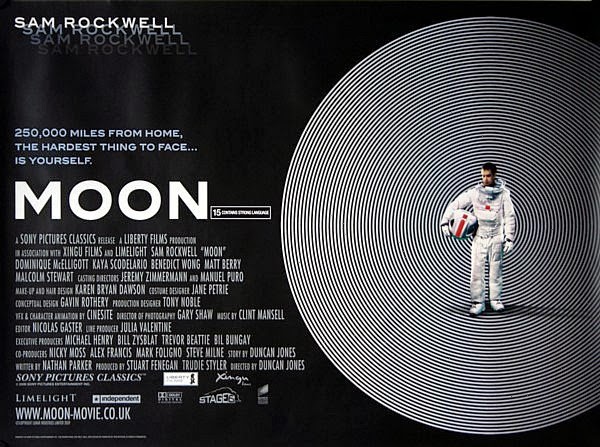
Moon versus Sun, by Ian Watson

This is a retrospective look at Duncan Jones´s much-lauded 2009 film Moon, with a wee bit concerning Danny Boyle´s slightly less lauded 2007 film Sunshine, written with the innocence of ignorance.  In other words I´m ignoring all the wealth of background info available to anyone who googles Wiki, and just going on my original first impressions.


In Moon, Earth is dependent for its power resources on Helium-3 scraped off the surface of our satellite by big mining machines (vaguely plausible) and sent to Earth in space torpedos.  Supervising all of this lunar activity is precisely one chap called Sam who lives in something the size of a modest shopping mall, under the illusion that he’s on a short-term contract.  (There’s another nifty  mall in the Dr Who Waters of Mars episode: enormous empty pressurised spaces for running through in panic, that must weigh hundreds of tons, although allegedly cargo space on the Mars-bound spaceship was so limited that they couldn’t even take a bicycle with them to cover the unnecessary distances from A to B and C and D and E.)

Sam non-communicates with his loving wife back home by recorded videos – none of that one-and-a-half second delay real-time communication nonsense such as has been popular since Apollo first landed.

As a companion in his solitude Sam has a clunky mobile Cyclops-eyed Artificial Stupidity which often advises him to visit the infirmary.  (Cue Hal from 2001: I–do–not-recommend-that, Sam…) For lo, unbeknownst to Sam, he is a clone with implanted false memories à la Phil Dick (think Total Recall); and his body will fall apart before too long – whereupon another clone will be awoken from the many in storage in the off-limits basement of the mall.

Evidently nobody in their right mind would ever wish, for scientific or any other reasons, to be paid to live on the Moon in a luxurious mall (especially when the mall benefits from normal Earth gravity, unlike outside where you need to move in lunar slow motion).  No, obviously you’d supervise Earth’s vital energy supply by using up, one by one, solitary clones that fall apart.  Cloning technology and cryo-storage of umpteen spares is so economical.

When Sam has an accident outside, the Artificial Stupidity mistakenly thinks he’s defunct and awakens another Sam, which leads to poignant Solaris moments of existential bewilderment, while melancholy celestial music à la Gattica plays at great length to establish a philosophical mood.  After a bit of a stand-off, Sam and Sam start playing ping-pong, which justifies the mall already being provided with a ping-pong table which usually requires a player at each end.

A discovery!  The torpedo which would supposedly send a Sam back to Earth after his stint is actually a highly efficient incinerator; there’s just a tiny trace of ash on the floor, which the Artificial Stupidity failed to completely vacuum up.

Moon so tries to be stylish and cool, but the problem is that the story is deeply silly.  Viewing the film as an unintentional farce from the outset will enhance one’s experience quite a bit.  I recommend Moon parties with a prize for the funniest catcalls.

Sunshine has a slightly dodgy idea too, namely that you can rekindle a dimmed sun by chucking a lot of our world´s fissile material into our star in the form of a superbomb.  I fancy you could toss the entire Earth into the sun without making much flicker of a difference to solar output, but never mind that.  Sunshine is so stylish and hot, as well as cool, that this doesn´t matter a hoot. Without going into details, since I don´t have enough time today (rather as Fermat scribbled in a margin that was too narrow for his Last Theorem) and since I feel metaphorical rather than analytical, Sunshine pushes all my buttons of, ahem, illumination. Emotional and dramatic and visual insight, rather than dimness, especially of wits.

(c) Ian Watson 2013

This originally appeared on The Ultimate Adventure Magazine website

Monday, 4 November 2013

Old Enough to Know Better but too Dumb to Care, an article by Rod Rees

NSFWG member Rod Rees on becoming a writer...


I’m thinking of declaring a jihad against actuaries.
Bastards.
My theory is that they’re in league with the government to stop me retiring. I’m getting to feel like Tantalus: every time the fruits of a pension come within reach they change the pensionable age and I’m back to square one looking for something to do that will provide me with three square a day.
And then, of course, when you could actually use an actuary – professionally rather than for fertiliser that is – there’s nary one of the buggers around. And, boy, the day I decided it would be a good idea to write a novel was sure as hell one when I could have used some advice of a statistical nature.
Gotta tell you, if deciding to write a novel is a dumb idea, then deciding to write one when you’re at the wrong end of your fifties is a really dumb idea.
Fifty is a funny age. It’s the Wednesday of your lifetime: too far from the fun-packed weekend of your youth and too far from payday ever to stand a chance. It’s the age – as Leonard Cohen so pithily reminds us – when we begin to ache in the places where we used to play. It most certainly is not an age to embark on novel writing. But then I suppose there’s no good age to start writing because it is – both actually and actuarially – a stupid occupation.
Okay, you need to be stupid to start writing a book. But read any guide to ‘writing a book’ and the word ‘determination’ features prominently, this being the trait considered necessary to finish writing a book. But in my case you can substitute ‘determination’ for ‘enraged naivety’. I was prompted to write ‘Dark Charismatic’ after watching the travesty of a re-imagining of the Jekyll and Hyde story that was the BBC’s ‘Jekyll’. Now although I love and revere Stevenson’s tale I nevertheless accept that like many things approaching their one hundred and twenty-fifth birthday (me, for example) it could certainly handle a wash and brush up. Unfortunately as wash and brush ups go the BBC’s effort was more akin to a really good sand blasting in that it stripped all the good things away and left ... well, not much actually. And like many before me, as I sat there aghast watching this twaddle, the thought crossed my mind, ‘I could do better than that’.
Fool! Such hubris!
So I sat down and wrote ... and wrote and wrote and wrote. Two hundred and twenty thousand words to be exact, each word of them carefully, lovingly and laboriously crafted. And the final two were ‘The End’.
Now here I pause to proffer my first statistic, namely, the one regarding how many books once commenced are ever completed. My guess – and I suspect this is an amazingly generous estimate – is that no more than one in a hundred neophyte writers ever stagger across the finishing line. Around the country there must be millions of first, second and third chapters gathering dust in drawers or languishing forgotten on laptops (and long may they remain there; who needs competition). And as support for this contention I am willing to bet, dear reader, that you too are the proud possessor of an unfinished novel.
So remember that statistic: only one in a hundred books is ever finished.
Having written the bloody thing I was troubled by a rather belated thought: what do I do with it now? And the answer is, of course, get an agent. Oh, you can do it yourself, sending your unsolicited manuscript to publishers directly but you might as well spend your time attempting to roast snow. Believe me, nobody in the publishing world will touch unsolicited manuscripts. They’re the tsetse fly of the literary world: everyone’s heard of them but no one wants to come in contact with them. So I googled ‘agents + science fiction + fantasy’, chose the three I thought most receptive – that is they had kind faces – and sent off the first three chapters of my magnum opus. And waited...and waited...and waited. One outright (or is that outwrite) rejection in the form of a platitudinous standard letter, one rejection because ‘the end of the book was obvious’ – the guy must be prescient or something because I didn’t know what the ending was until a week before I sent it off – and – hurray! – one acceptance.
So back to those statistics. In later conversation with my agent (get me: ‘my agent’) he advised me that during his time in the business he’d received something north of six thousand submissions from would-be writers and as he’s currently got a stable (or should that be a pen) of forty-three authors that comes out at a newby having something like one chance in a hundred and fifty of securing an agent.
Remember that: you’ve one chance in a hundred and fifty of finding an agent.
So ‘Dark Charismatic’ was sent out ... and every publisher and his father rejected it. The general feeling was that there was too much sex in it. My fault: in retrospect what I’d written was an over-long aide-memoire, something to refer to if Alzheimer’s kicked in and I found myself with some free time on a Saturday night. So what do I do now? As I’d just spent a year wasting my time, writing unpublishable crap and earning precisely zip, the answer was obvious: I’d write another book! I think this sort of behaviour is classifiable under Obsessive Compulsive Disorders. Anyway, thus was born ‘The Demi-Monde’. Another year drifted by but this time when my agent pitched the book it was taken up by a publisher.
Remember that: there’s only one chance in two of your agent being able to find a publisher for your book.
Okay, so you’ve got a publisher now, so let’s have a look at the sales prospects for your master work. Somewhere between seventy thousand new fiction titles hit the bookshelves every year in the UK and the average sales of each are somewhere between one thousand and three thousand copies. That’s average, folks, so there are some seriously shit sales needed to compensate for the stellar success of such luminaries as Dan Brown and Stieg Larsson. No matter, these average sales, by my calculations, will net the author between £500 and £1,500. That’s after two years bloody hard work (and don’t forget you’ll also have to go through the publisher’s editing process which can be enormously time consuming, especially if your grammar is as rotten as mine ... or, possibly, mine is): that works out at about 10p an hour. Minimum wage it ain’t. It makes misdirecting customers at B&Q look like a gig from heaven.
So what are your chances of your book generating something approaching a reasonable return on your investment of time – say £30,000 a year? My guess is that maybe two and a half thousand titles turn that sort of profit for their authors: one in thirty.
Remember that: one book in thirty turns an okay profit.
If I recall my statistics – and those lectures were a bloody long time ago – the chance of you finishing a book, finding an agent, having it published and turning a reasonable profit is about one in forty thousand. Or about the same chance you run of being struck by a renegade meteor ... on a Sunday ... in Slough.
That’s why, in my humble opinion, the chief quality needed by a would-be writer isn’t determination, or creativity, or style, or a wonderful plot idea ... it’s stupidity. No matter how you slice it, writing’s a mug’s game.
But to paraphrase Lloyd in ‘Dumb and Dumber’: ‘One chance in forty thousand? So you’re telling me I’ve got a chance’.

What do actuaries know anyway?